Three years ago, Neha started a small design studio in Ahmedabad. For her first client, she quoted ₹25,000 for a brand identity. She picked the number in one anxious evening, mostly by guessing what the client would not refuse.
Since then she has hired two designers, moved into a proper office and started delivering work she is genuinely proud of. Rent has gone up. Salaries have gone up. Her software subscriptions have doubled.
Her price is still ₹25,000.
Nobody decided to keep it there. It simply never came up. Each new client was quoted what the last one paid. Slowly the number turned from a guess into a fact.
This is common in growing businesses. Costs get reviewed every month because bills arrive every month. Price gets reviewed almost never because nothing forces the question. So a business improves in every way except the one number that decides what it earns.
The cost of that silence is bigger than it looks. In a 1992 Harvard Business Review article, McKinsey consultants Michael Marn and Robert Rosiello estimated that for a company with average economics in their data, a 1% price increase lifted operating profit by about 11%. A small studio will have different numbers. The logic still holds. Price moves profit faster than most levers because an increase carries no extra cost.
There is a quieter cost too. Clients read price as a signal. A studio doing better work at an old rate can look less confident than one that charges fairly.
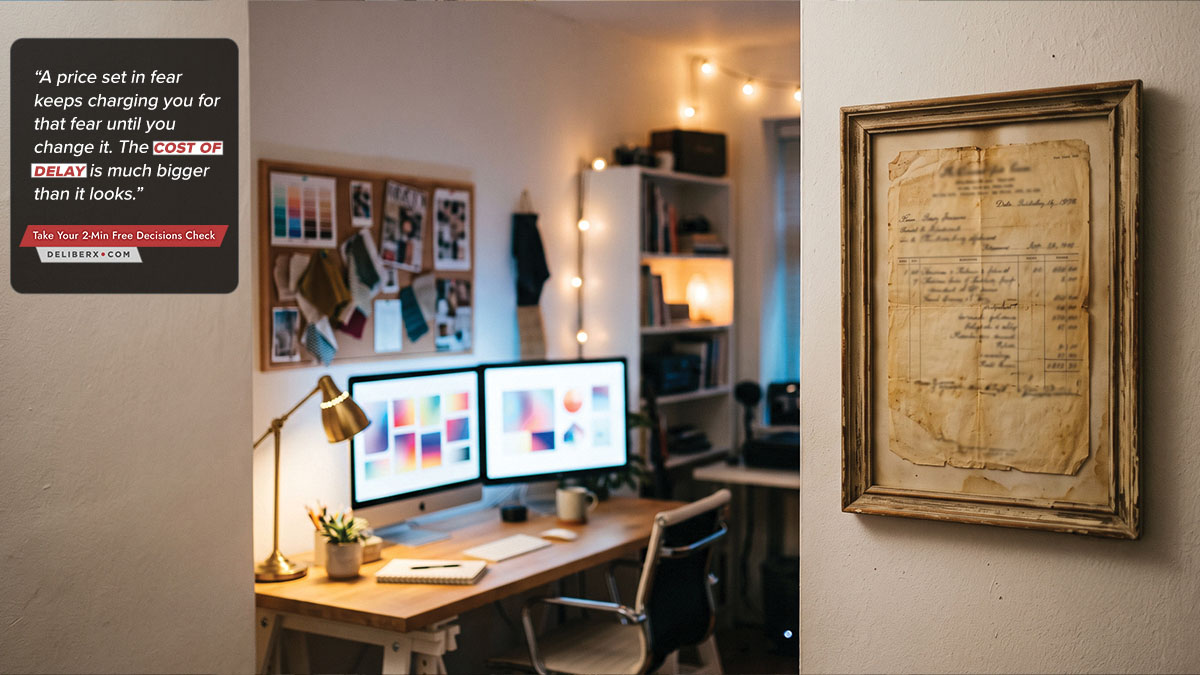
A price set in fear keeps charging you for that fear until you change it.
A price is a decision. Decisions deserve review dates. Put one in your calendar at least once a year and ask what has changed since you last set it. Your costs. Your quality. What clients say when they recommend you. What others now charge for similar work.
You do not need to shock existing clients. Raise prices for new ones first. Give old clients notice. Explain what has improved. Clients who value the work usually stay. Those who leave over a fair increase were mostly staying for the discount.
If you cannot remember the last time you actually decided your price, you are still running the business on the guess you made in your first nervous month.
DeliberX Ref: DXB-4.3 · Price leverage (Marn & Rosiello, HBR 1992) · Give your price a review date
Costs get reviewed every month. The price that pays for them rarely does.
Whether you set numbers by value or by old fear is a pattern the Decision Check brings into view.
→ Take the 2-minute Decision Check